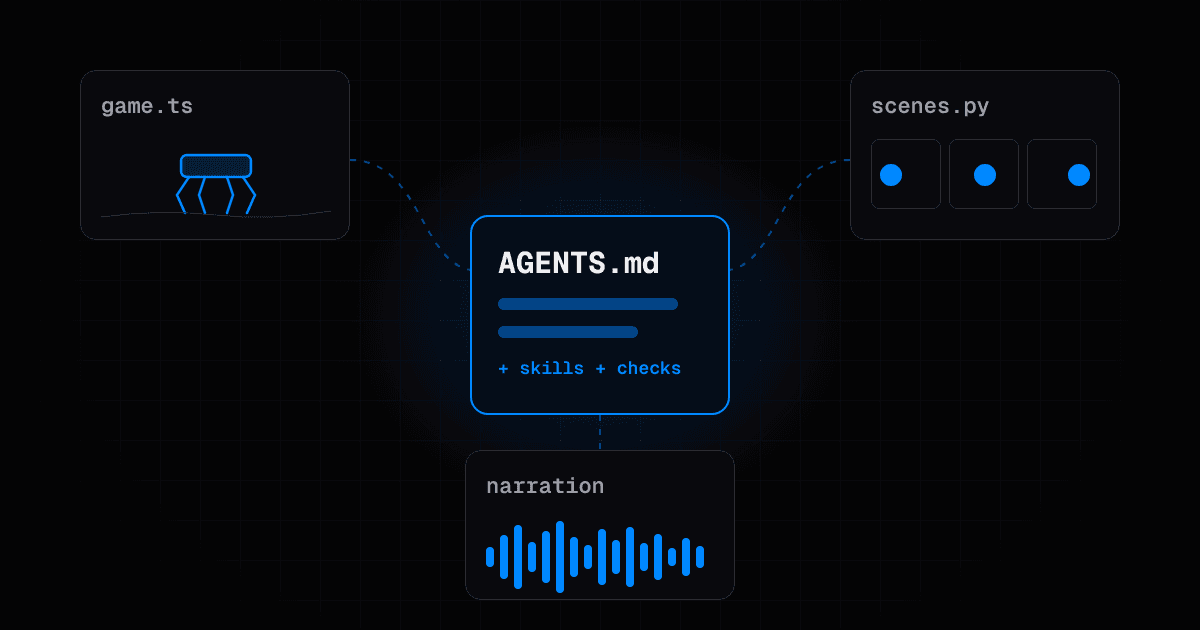
In October, one paragraph about a four-legged robot exploring a planet turned into Rover, a 3D browser game you can play on a laptop or a phone. It took 27 commits over three short sessions, and Claude Opus 5.5 is the co-author on every one. Around the same time, a folder of script files turned into See Why, a YouTube channel of animated science videos for kids, narrated by an ElevenLabs voice. No video editor was involved.
Neither project is a typical web app, and neither came from one clever prompt. What made them work was the setup around the agent: a written brief, tests for the parts that can be tested, a way for the agent to look at its own output, and a few rules that keep it from wasting effort or money. That setup is the part worth copying, so this post walks through it using what's actually in the two repositories.
It's written for developers who already use Claude Code, Codex, Cursor, or a similar agent on app code and want to know how far it goes beyond that.
A 3D game: Rover
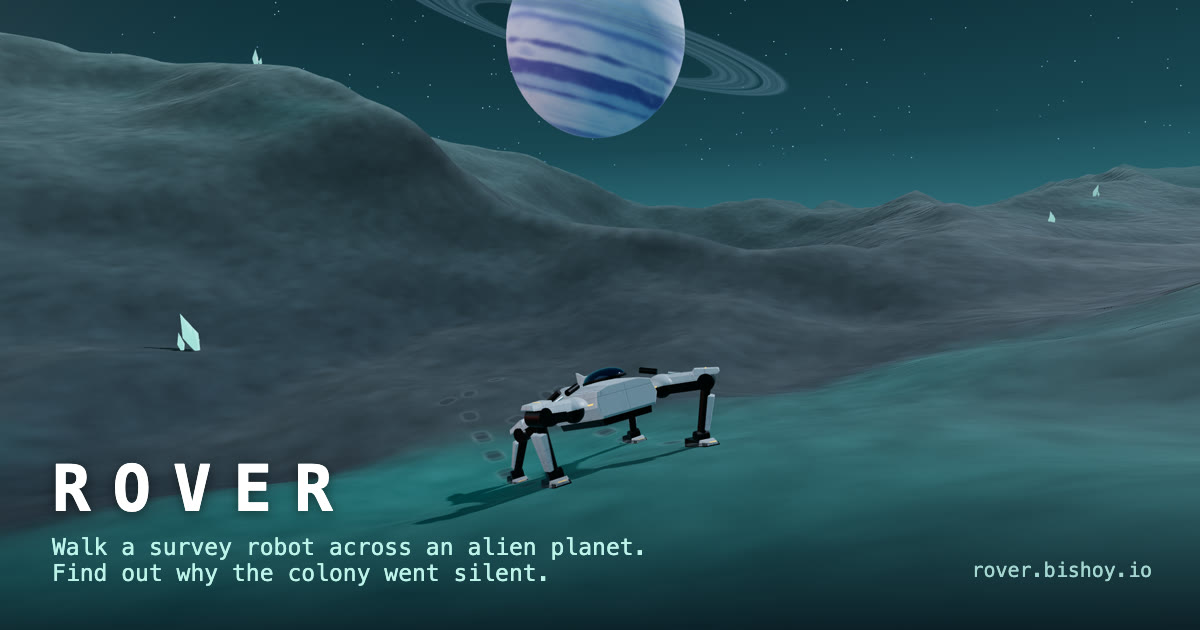
In Rover you walk a survey robot across a generated alien planet, drill core samples in a pressure-and-heat minigame, and piece together why a colony went silent. The legs use inverse kinematics, so each foot lands on the actual ground and slopes change the walk. It's built with React Three Fiber and Three.js.
Start with a brief, not code
The game started from one message:
I want to explore a 4 legged robot exploring a planet, 3d camera is on top of the robot, the robot is searching for something, trying to know what happened, drilling holes, the land is auto generated
The first step wasn't to ask for code. It was to have an agent turn that message into a one-page AGENTS.md covering the premise, the core loop, how it should feel, a suggested stack, and a deliberately small first version with a definition of done:
## First playable slice

Build this before anything else, and keep it small:

1. One generated area (a few chunks) with a fixed seed.
2. The robot walking with IK legs that plant on the terrain, and the mounted camera.
3. A scanner that points toward the nearest anomaly.
4. One drill with the pressure/heat minigame and terrain deformation.
5. Three clues that lead to a single reveal screen.

Done means: it runs at 60 fps on a mid-range laptop, is playable on a phone, and
someone who has never seen it can finish the slice without instructions.
Two rules in the same file shaped the whole project. "Prefer feel over features: polish walking and drilling before adding new systems" keeps the agent from bolting on menus and inventories before the robot even walks well. "Keep game logic in plain TypeScript modules with unit tests; keep rendering in components" turns the leg math, the walking gait, the drill model, and the clue grading into ordinary code the agent can test. Rover has 21 test files for that logic, and one command, pnpm check, runs lint, typecheck, tests, and a production build before any work is called done.
Let the brief keep a record
The brief didn't stay a plan. The agent kept updating AGENTS.md as it worked, recording the things a future session would otherwise have to rediscover. Some are decisions: physics isn't installed yet, because a simple height lookup is exact and cheap enough for placing feet. Some are dead ends: "Legs stay two-segment (a three-joint experiment made movement look wrong)" and "No camera shake on footfalls: it made the view too noisy."
For the bigger features, the agent wrote a short spec and plan before touching code, using the superpowers skills. The plan even tells reviewers what to look for, for example: "A re-drill that comes out worse must not downgrade the stored sample."
The git history shows the pace. The first session produced the generated world, the walking robot, the scanner, the drill, and a live deploy, with about 80 minutes between the first and last commit. A second session of about 30 minutes added the story, the graded samples, and the ending. A third added touch fixes, sound generated in code, meteor showers, and creatures drawn to the drill. Commit times aren't the same as time worked, but the game was playable after every one of the 27 commits.
Give the agent a way to see
Tests can't tell you the screen is black. Rover's repository includes a Claude Code launch config that starts the dev server, so the agent can open the game in its built-in browser and look at what it built. If your agent has no browser, a headless Playwright script that screenshots the canvas and fails when it's blank does the same job.
Animated videos: See Why

Each See Why video answers one question a kid would ask, like Why Is the Sky Blue?, in about four minutes. Six episodes were made in one repository, each with a video, a vertical Short, a thumbnail, captions, a free lesson pack for teachers, and a page on the channel's site. The whole pipeline is Python code the agent can read, run, and change.
The brief is a style guide
The channel's AGENTS.md opens with "This file is the source of truth for every video on the channel," and it reads like a studio's style guide. It fixes the format (one question, three to five minutes, the same six-part structure every time) and the writing rules (a grade 5 to 6 reading level, one new term per video, and "Simplify, never falsify," with every simplification flagged and every script fact-checked against listed sources). It also fixes the look, down to the color palette, with yellow reserved for "the thing to look at right now," and how long a typical animation takes. And it sets approval points: a new character or look needs one approved still before a whole episode is built with it.
Scripts the code can read
Every episode has a script.md table where each narration line sits next to a note on what's on screen, and / marks a pause:
| Narration | Visual |
|---|---|
| Look up on a sunny day. / Blue. / Bright blue, / from one side of the sky to the other. | Flat landscape: green hill, a kid seen from behind looking up, sun top right. The sky fills in blue from the horizon up, left to right. |
The pipeline reads this table directly. Each row becomes a line of narration, and each / becomes a moment the animation can be timed to.
Every frame is code
The tools README puts the core idea in one line: "every frame is draw(canvas, t), pure in t." A scene is a Python function that draws the picture for any moment in time, and the renderer runs it for every frame and encodes the result as a 1080p video with ffmpeg. Because the same moment always draws the same picture, re-running a step always gives the same output. Characters and props are built once in shared files and then posed, so the kid on the hill looks the same in every episode.
The check: stills from the real code
An agent can't watch a video, but it can look at pictures. One command renders a still at the end of every spoken phrase, straight from the final animation code, which gives episode 5 a storyboard of 109 frames that always matches the video.

This is the frame where the episode's main idea lands. The agent compares stills like this with the script's visual notes and fixes anything cut off, overlapping, or showing at the wrong moment. Stills can't judge pacing, so a person still watches the full video.
If you'd rather build video in React, Remotion works on the same idea and publishes its own agent skills.
Voice: ElevenLabs narration
The narration comes from the ElevenLabs API, called by the pipeline like any other build step. Three choices make it dependable.
The voice is locked in a file. A small audition script reads the same test lines in several voices, and the chosen voice, model, settings, and a fixed seed go into brand/narrator.json. The brief says the channel keeps one narrator for the whole series, so the voice is never a choice the agent gets to make.
The picture follows the words. Each line is sent with the lines around it, so the reading flows, and ElevenLabs returns when each character is spoken. The pipeline uses those timings to find where each / phrase starts and ends, and the animation lines up with them. When the narration changes, the animation moves with it.
You only pay for what changed. Every generated line is cached under a hash of its text and settings, so after a script edit only the edited lines are sent again. Before a script is approved, the macOS say command stands in as a free draft voice, so the timing can be worked out before any credits are spent.
What still needs a person
The repositories make it clear where people stay in charge. Ideas and taste come from a person: Rover started from that one paragraph, and new looks for See Why need an approved still before they're used. Picking the narrator meant listening to auditions. Every script is fact-checked against its sources, with a second read tracked as its own task. And no test, still, or build can say whether a walk feels heavy enough or an explanation clicks. That still takes someone playing the game or watching the video.
Two practical limits matter too. Generation costs money, so cache everything and never let an agent regenerate in a loop until something "sounds right." And keep API keys in your environment or an uncommitted .env file, which is exactly what See Why does.
Try it yourself
Pick something you'd normally assume is out of reach for an agent, and start with the brief instead of the prompt. Describe the idea in a few sentences and ask your agent to turn it into a one-page AGENTS.md with a premise, a stack, a small first version, and a definition of done. Keep the rules and math in plain, tested modules, separate from whatever draws to the screen. Give the agent a way to see its output, whether that's a browser preview, rendered stills, or audio timestamps, and tell it to check before it says it's done. Then ask it to write its decisions and dead ends back into the brief, so the next session starts where this one stopped.
For the repository side of this setup, see what an agent-ready repository needs. Then play Rover and watch Why Is the Sky Blue? to see where it led.